Interview with JLG’s Nate Hoover: Safety is the Foundation
Nate Hoover, senior director of product management, JLG, talks about demand for higher-capacity models, the growth of data centers, collision-prevention technologies and more.
RER: What are the most important developments in mobile elevating work platforms in the past year - especially technology that would be of interest to rental companies?
Hoover: Some of the most significant developments in MEWPs over the past year have centered on productivity and safety — and that’s where rental companies are seeing the most value. Safety remains the foundation of MEWP design, and what matters most for rental customers is when it is integrated into the machine.
At the same time, users are increasingly demanding MEWPs that deliver greater performance, durability and reliability. With tighter project timelines and industry-wide labor shortages, end users need equipment that allows them to move fast and complete more tasks without downtime. This has driven demand for higher-capacity models that can lift more tools, materials, and workers at once, as well as for machines that reposition efficiently while elevated, simplifying workflow on the job.
From a serviceability and fleet management perspective, features like quick-swap platforms help rental companies minimize downtime by making it faster to replace damaged platforms or to fit trade-specific accessories. In addition, connectivity solutions now give owners real-time visibility into diagnostics, machine health, and utilization — all of which help reduce surprises and improve fleet efficiency.
Improvements in the operator experience are another key area of development. Intuitive displays, along with features such as perimeter lighting and exclusion zones, make machines easy to use while also providing a visible perimeter around your machine. Together, these advancements give rental companies the ability to offer equipment that keeps their customers productive, efficient and confident that the machine will perform every day.
What’s new in your company’s MEWP offering over the past year or so?
Hoover: Within the past year, JLG introduced a new mid-rail deck system for both boom lifts and scissor lifts, which directly addresses the need for additional access height. This solution allows crews to productively work on job sites that require access to tight spaces at height.
Additionally, we’ve continued to expand our line of higher-capacity models, providing rental companies with more versatile machines that can handle heavy materials. Alongside this, we’ve simplified fleet upkeep with the introduction of the rapid replaceable platform technology, reducing downtime by making it easier to replace damaged platforms or to fit trade-specific accessories.
Connectivity remains a key development in the rental industry. Through JLG’s ClearSky Smart Fleet IoT platform, rental companies can access machine diagnostics, monitor utilization, and even connect to manuals and knowledge resources in real time, to better understand what’s going on inside the machine, but they also will soon have access to the system’s newest capabilities, including automated site networks, elevation-based location, over-the-air machine software updates and digital analyzer reader.
What are some of the most interesting applications for MEWPs that you’ve seen currently or over the past year or so?
Hoover: We’ve seen a number of new and expanding applications for MEWPs over the past year. One of the biggest drivers is the growth of data centers, which is happening across North America and Europe. These facilities require extensive overhead installation and maintenance work, and MEWPs are critical tools for accessing high, confined or complex spaces.
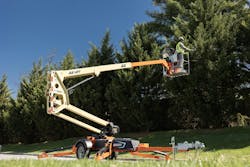
Another interesting area is the use of compact crawler boom lifts by arborists. These machines are perfect for navigating tight outdoor environments while providing working access at height — a segment where demand continues to grow.
We’re also seeing strong adoption of MEWPs in distribution centers and warehousing industries that are booming with the rise of e-commerce. Similarly, modular building construction has emerged as a growing segment, where the precision and flexibility of MEWPs are increasingly valued.
On the technology side, there’s a continued move toward hybridization — MEWPs designed to replace internal combustion units in indoor applications, helping reduce emissions while still delivering performance. We’re also seeing increased interest in integrating work site monitoring into machine design and operation.
Together, these applications demonstrate how the versatility of MEWPs continues to find new opportunities in both established and emerging industries.
Rental companies can all read the manufacturers instruction or IPAF “how to use” documents, and pass that documentation on to the customers, but what are some of the most important tips or suggestions for safety on aerial equipment that you would like to pass along to rental companies? What are the most common mistakes renters of aerial equipment make?
Hoover: While rental companies already have access to standard safety documentation, there are a few key points that are worth emphasizing from our perspective. First and foremost is loading and unloading machines from trailers. This is one of the most critical moments in a machine’s lifecycle.
Another important consideration is making sure the machine is properly matched to the job. Equipment that isn’t the right size or type can lead to unsafe workarounds. Rental companies play an important role in guiding customers to the right machine for their application.
Education and familiarization are also essential. Rental companies should provide operators with comprehensive orientation materials and ensure that crews have the necessary information to operate machines safely and effectively.
Finally, it’s important that equipment leaves the rental yard operationally ready. That means it’s been fully inspected, properly maintained, equipped with the right accessories, and confirmed to be jobsite ready. Preventive maintenance and a rigorous service process are vital to ensuring that rental customers receive reliable, safe equipment every time.
Looking ahead, what are the next new development or developments in aerial equipment technology? What are some developments you would like to see? What’s on the horizon?
Hoover: Looking ahead, we see several important developments on the horizon. Connectivity will continue to grow in importance. JLG’s ClearSky Smart Fleet platform is expanding rapidly, with new capabilities and functionality continually being released to deliver more value in diagnostics, machine data and access to content. For rental companies, this connectivity will translate into more efficient fleet management and improved uptime.
We’re also the industry moving toward more advanced collision avoidance technologies, which will provide an added level of awareness while allowing operators to remain productive. Beyond collision avoidance, there’s a trend toward expanding the utility of MEWPs through smarter accessories. For example, rather than just offering a platform attachment that stores job site materials, there are opportunities through robotics to explore ways to design accessories that actively assist in lifting and positioning these materials. The goal is to integrate more of the job’s physical demands into the machine itself, reducing strain on workers and improving efficiency.
At the same time, we see increasing potential in automation and machine orchestration. For example, at CES 2025, we demonstrated how an Autonomous Mobile Robot working alongside a MEWP can transport equipment, carry additional energy for charging and support operators. This kind of collaboration between machines opens up new possibilities for productivity and utilization on complex job sites.
Finally, we believe there’s enormous value in improving access to resources. Through platforms like ClearSky Smart Fleet and Online Express, operators and rental companies will be able to connect instantly to manuals, training content and knowledge articles — all of which help make sure machines are used safely and effectively.
Together, these advancements paint a picture of a future where MEWPs are not only safely operated and more capable, but are also smarter, more connected and more integrated into the way work gets done.
About the Author
Michael Roth
Editor
Michael Roth has covered the equipment rental industry full time for RER since 1989 and has served as the magazine’s editor in chief since 1994. He has nearly 30 years experience as a professional journalist. Roth has visited hundreds of rental centers and industry manufacturers, written hundreds of feature stories for RER and thousands of news stories for the magazine and its electronic newsletter RER Reports. Roth has interviewed leading executives for most of the industry’s largest rental companies and manufacturers as well as hundreds of smaller independent companies. He has visited with and reported on rental companies and manufacturers in Europe, Central America and Asia as well as Mexico, Canada and the United States. Roth was co-founder of RER Reports, the industry’s first weekly newsletter, which began as a fax newsletter in 1996, and later became an online newsletter. Roth has spoken at conventions sponsored by the American Rental Association, Associated Equipment Distributors, California Rental Association and other industry events and has spoken before industry groups in several countries. He lives and works in Los Angeles when he’s not traveling to cover industry events.